
The festive season is the most valuable trading period of the year for hospitality kitchens, and the hardest on them. Year-end functions, full dining rooms, holiday guests and seasonal staff all arrive at the same time. Every hygiene system in the kitchen gets pushed to its limit.
Most festive-season kitchen failures don’t start in December. They start with build-up that has been quietly accumulating for months: grease in the trap, biofilm in the drains, residue on surfaces. Peak trading simply exposes it.
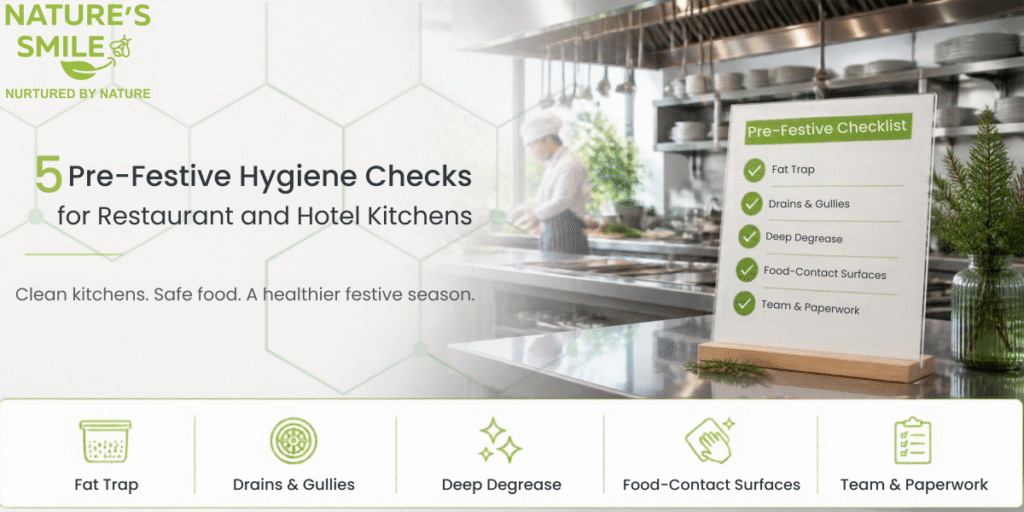
As bio-enzyme cleaning specialists, we see the same pattern every year. The kitchens that get through December smoothly are the ones that deal with these problems at the source, before the rush begins. Here are five checks worth doing now:
1. Get your fat trap to a clean baseline
Your fat trap is the system most likely to fail at the worst possible moment. Festive trading means more cooking and more fats, oils and grease (FOG) going down the drain. A trap that is already carrying a thick grease cap has no room to absorb that spike.
- Check the service history – When was the trap last pumped out or treated? If nobody knows, that is your answer.
- Look at the FOG layer – A solid crust on the surface means the trap is working at reduced capacity.
- Watch for warning signs – Slow sinks, gurgling drains and odours near floor gullies all point to a trap under strain.
- Move from reactive to biological – Instead of waiting for a blockage, a consistent bio-enzyme treatment programme uses natural enzymes and beneficial bacteria to keep breaking down FOG every day. The trap stays functional between pump-outs rather than slowly filling up.
A blocked trap mid-December means emergency call-outs, odours in guest areas, possible downtime and the risk of breaching municipal wastewater discharge by-laws. Starting the season from a clean baseline is far cheaper than a crisis at peak trading.
2. Clear the drains and floor gullies you can’t see
Floor drains, gullies and the pipework between your kitchen and your fat trap collect a mix of grease, food particles and biofilm. This is where most kitchen odours start, and where pests find food and shelter.
- Lift the drain covers – Check for visible build-up and food waste.
- Note persistent odours – A smell that returns soon after cleaning usually means organic matter is sitting inside the pipework, not on the surface.
- Treat the cause, not the smell – Masking agents and harsh drain chemicals only deal with symptoms. Bio-enzyme drain treatments digest the organic matter causing the odour, without damaging pipes or harming the biological activity your fat trap depends on.
3. Deep-degrease before volume rises
Grease build-up on extraction canopies, filters, fryers, walls and floors is a hygiene issue, a slip hazard and a fire risk – and all three get worse as cooking volume increases.
- Pull out heavy equipment – Clean behind and under fryers, ovens and fridges at least once before the season starts.
- Check extraction filters and canopies – Grease-laden filters reduce airflow and increase fire risk.
- Use the right dilution – A concentrated degreaser used at the correct ratio cleans more effectively and costs less per litre of working solution than over-using a weak product. Getting dilution right is one of the simplest ways to protect both your results and your budget.
4. Review what’s touching your food-contact surfaces
In a busy kitchen, the products used on prep surfaces, cutting boards, equipment and utensils matter as much as how often they are cleaned.
- Separate cleaning from disinfecting – Detergents remove soil; disinfectants kill microorganisms. Surfaces need to be cleaned first so the disinfectant can do its job.
- Respect contact times – A disinfectant only works if it stays on the surface for the time stated on the label. Under pressure, this is the step staff skip most often.
- Ask for proof, not promises – Food-contact products should be independently tested and certified, with documentation you can show an inspector. Bio-based options such as lactic acid disinfectants offer certified performance without the harsh residues associated with many conventional chemicals, which matters on surfaces that touch food.
5. Prepare your team and your paperwork
Your systems are only as strong as the people running them, and December brings new and temporary staff into the kitchen.
- Stock every hand wash station – Soap, paper towels and warm running water, kept clear of clutter. A station that is hard to reach doesn’t get used.
- Induct seasonal staff before their first shift – Hand washing, cleaning schedules, dilution rules and contact times, explained simply.
- Make illness reporting safe – Staff should know that reporting vomiting or diarrhoea is expected, not penalised.
- Get your records in order – Your Certificate of Acceptability, cleaning logs, pest control reports and fat trap service records should be current and easy to find. Under South Africa’s food premises hygiene regulations (R638), these records are your evidence that hygiene responsibilities are being met.
Why it matters
The festive season rewards preparation. A few hours spent on these five checks now can prevent blocked drains, failed inspections, staff injuries and unwell guests during your busiest weeks. And when hygiene problems are treated at the source – biologically, rather than masked or flushed downstream – they stay solved for longer, which is exactly what a kitchen running at full capacity needs.
Nature’s Smile helps restaurants, hotels and food production sites across Gauteng prepare for peak trading, with biological fat trap treatment and our certified LactiClean food-grade hygiene range. If your kitchen needs a pre-festive check, we’re happy to help.

