
South Africa’s food service industry is entering a period of tighter scrutiny. Between evolving national legislation, more assertive municipal enforcement, and growing consumer expectations around traceability, hygiene compliance has moved from a back-of-house checklist item to a front-line business risk. For restaurant groups, hotel kitchens, and catering operators, understanding where the pressure is building – and where the gaps usually are – is now a competitive advantage, not just a legal obligation.
Here’s what’s shaping the compliance landscape this year, and what operators should be doing about it.
1. Regulation R638 is no longer a once-off box to tick
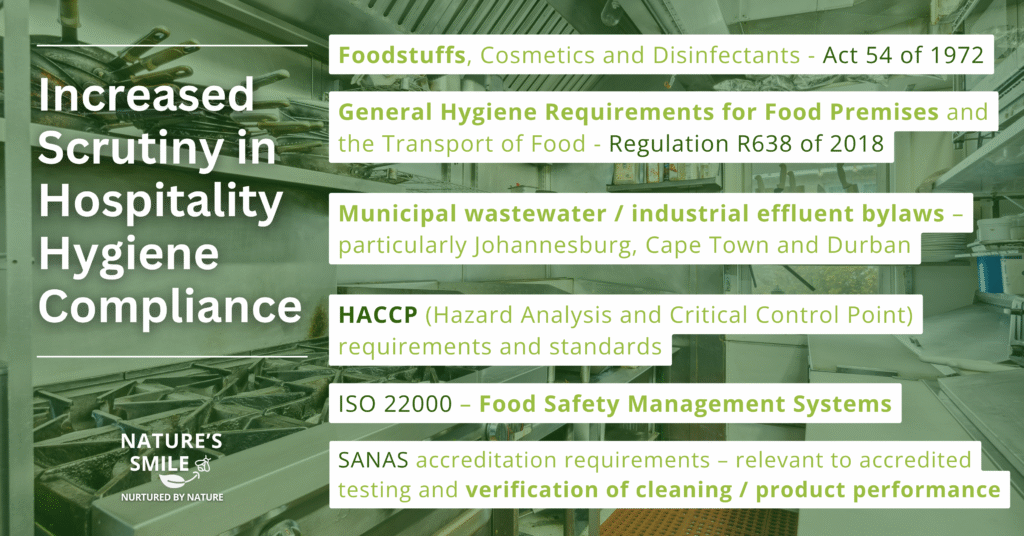
Every food premises in South Africa needs a Certificate of Acceptability (CoA) under Regulation R638 of 2018, issued by the local municipality’s Environmental Health department under the Foodstuffs, Cosmetics and Disinfectants Act. That much is well known. What’s changed is the posture of enforcement: inspectors are increasingly treating R638 compliance as an ongoing operational standard rather than a certificate to renew and forget. Structural requirements – cleanable surfaces, ventilation, lighting – are being assessed alongside day-to-day practice: how staff actually handle food, how surfaces are actually cleaned, and whether documentation matches reality on the day of inspection.
For larger contracts and institutional catering, the bar is rising further. HACCP certification and ISO 22000 food safety management are becoming the expected standard rather than a nice-to-have, particularly for tenders and multi-site operators.
What this means for operators: Treat your CoA as a living compliance posture, not a certificate on the wall. Build hygiene checks into daily shift routines, not just pre-inspection scrambles.
2. Labelling and traceability rules are tightening
Draft labelling regulations first published in 2023 are expected to be finalised this year, replacing older labelling rules. Alongside this, food businesses remain accountable under a stack of overlapping legislation – the Foodstuffs, Cosmetics and Disinfectants Act, the National Health Act, the Meat Safety Act, and the Consumer Protection Act. Non-compliance carries real teeth: criminal prosecution, immediate closure, loss of retailer or distribution listings, and civil liability are all live consequences, not theoretical ones.
What this means for operators: If your supply chain touches packaged or resold food items, traceability documentation needs to be audit-ready at all times – not assembled reactively when an inspector arrives.
3. Grease and wastewater compliance is becoming a genuine enforcement priority
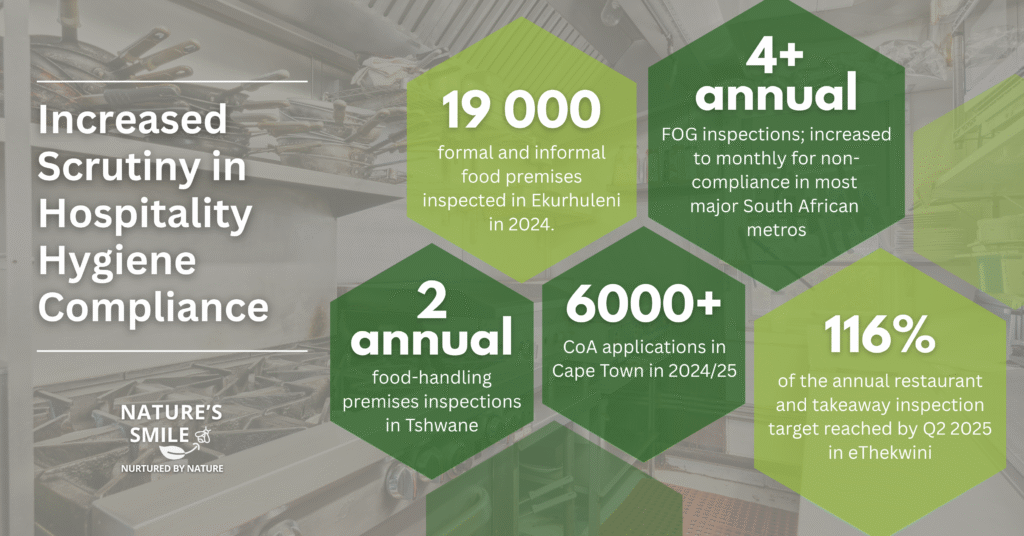
This is where many hospitality operators are still under-prepared. Municipal wastewater bylaws in Johannesburg, Cape Town, and Durban require functioning, properly maintained grease traps in any kitchen producing fats, oils, and grease (FOG). Non-compliance can trigger fines, suspended operating licenses, or withdrawal of an industrial effluent permit.
What’s notable is how often “compliant on paper” doesn’t mean compliant in practice. Industry research has repeatedly found food outlets with grease traps installed that still breach bylaw discharge limits – not because the equipment is missing, but because maintenance is inconsistent, logs aren’t kept, or the trap simply isn’t sized or serviced for the kitchen’s actual output. Municipalities are asking for maintenance logs and waste transfer certificates first during inspections and increasingly conducting unannounced checks.
What this means for operators: A grease trap is only as compliant as its maintenance record. Monthly inspection, documented servicing, and a licensed waste transfer certificate retained for at least two years are the minimum standard – and the first thing an inspector will ask to see.
4. The credibility gap is now a commercial risk, not just a regulatory one
Beyond fines, there’s a reputational dimension operators can’t ignore. In an environment where a single viral customer complaint or a failed inspection can circulate faster than any marketing campaign, demonstrable hygiene compliance is becoming part of the brand promise – especially for operators competing for corporate catering contracts, hotel group standards, or franchise accreditation, where proof of a working food safety and effluent management system is now a tender requirement, not a courtesy.
Where operators are getting caught out
In our experience working with kitchens and food production sites across Gauteng, the most common compliance gaps aren’t dramatic. They’re small, structural, and cumulative:
- Grease traps installed but not serviced on a documented schedule
- Cleaning products used inconsistently with no verification of actual biological effectiveness
- Maintenance and cleaning logs that exist but aren’t kept audit-ready
- No clear ownership internally for who is accountable for compliance day-to-day
None of these require large capital outlay to fix. They require discipline, the right products, and a system that makes compliance the path of least resistance for kitchen staff – not an afterthought bolted on before an inspection.
Raising the bar on verified compliance
One shift worth watching is a move away from products that simply claim to be “eco” or “food safe” toward products that can prove it. SANAS-accredited testing is increasingly the credibility marker operators and auditors are looking for, because it removes the guesswork from whether a cleaning or treatment product actually performs as claimed.
This is the thinking behind our own newest range: a lactic acid based line, independently SANAS-certified, developed specifically for food production and hospitality environments where verified performance – not marketing claims – is what stands up to an audit. For operators building a defensible compliance file, having SANAS-backed documentation behind the products used in your kitchen is one more piece of evidence that closes the gap between “compliant on paper” and compliant in practice.
The bottom line
Hygiene compliance in South African hospitality is shifting from a static certificate to an ongoing operational discipline – covering everything from surface cleaning practice to what’s happening inside your grease trap. Operators who treat compliance as a continuous system, backed by real documentation and effective biological treatment methods, will be the ones who move confidently through inspections, retain institutional contracts, and protect their brand reputation.
The operators who treat it as a once-a-year certificate renewal are the ones most exposed.
References
1. Hygiene Heroes. “Food Safety Compliance in South Africa: R638, HACCP & Hygiene Standards.” hygieneheroes.org.za
2. ASC Food Safety. “South African Food Legislation 2026: Full Guide.” ascfoodsafety.com
3. ASC Food Safety. “Food Safety Legislation South Africa.” ascfoodsafety.com
4. Monument Cleaning Solutions. “Food Safety Legislation in South Africa.” monumentcs.co.za
5. Drain Blasters. “Grease Trap Regulations in South Africa Explained.” drainblasters.co.za
6. Drain Blasters. “Grease Trap Inspection Checklist for Restaurant Owners.” drainblasters.co.za
7. Initial South Africa. “Restaurant Hygiene Challenges, and How Initial Solves Them: Part 2.” blog.initial.co.za
8. Drainmen Plumbing Services. “Grease Trap Compliance: What Every Facilities Manager in South Africa Should Know.” drainmen.co.za
9. The Specialists. “Fat Trap Cleaning.” thespecialists.co.za
10. Water Institute of Southern Africa (WISA). “Reduction and Monitoring of Fat, Oil and Grease.” wisa.org.za

